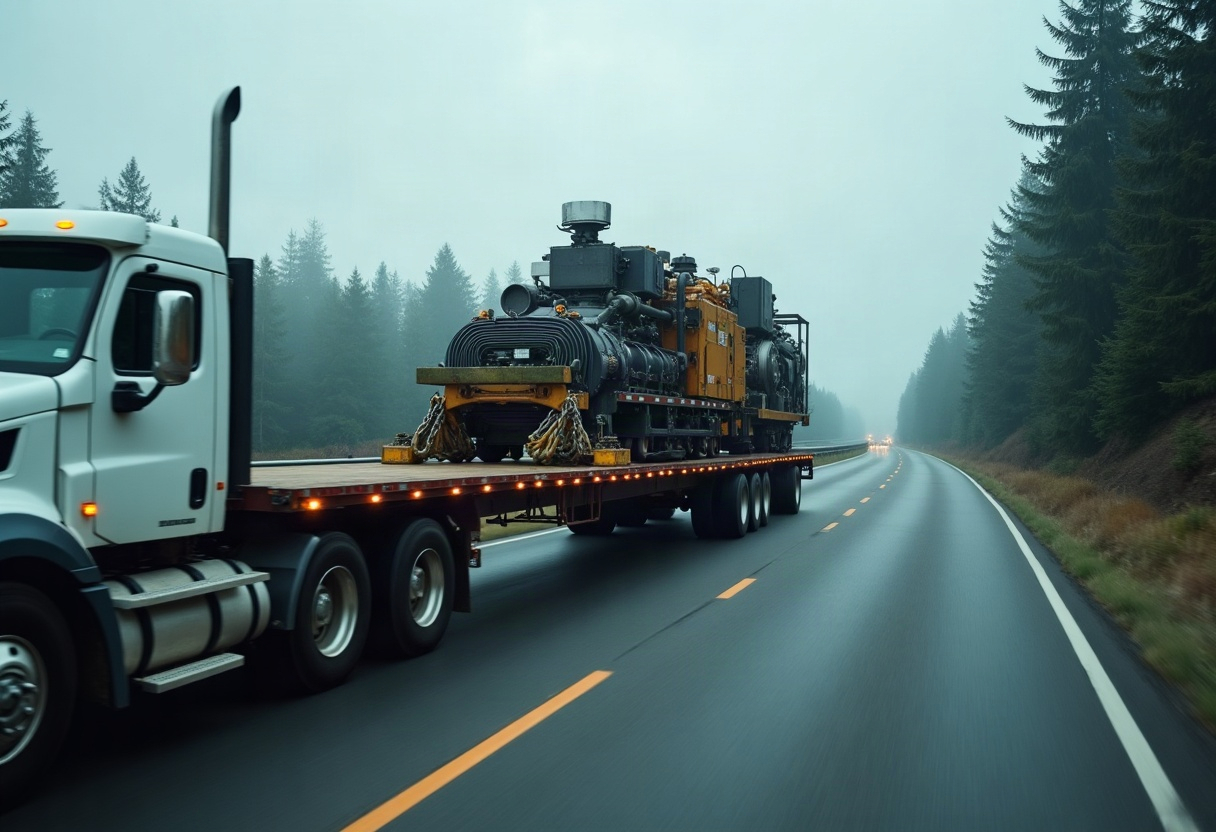
Moving Heavy Equipment by Truck in the Pacific Northwest
Transporting machinery is not the same as hauling palletized freight. A lathe that weighs 12,000 pounds, a CNC mill that is 9 feet wide, or a generator that needs to clear a low bridge — each load presents a different set of constraints. Machinery transport requires the right trailer, a driver who understands load securement, and a plan for permits, routing, and scheduling.
SeaSound Transport moves machinery and heavy equipment from its yard at 28227 85th Ave S in Kent, WA, to destinations throughout the Pacific Northwest. With a fleet of five power units and interstate operating authority, we handle both local moves within the Kent-Seattle-Tacoma corridor and long-haul deliveries across state lines.
What Counts as Machinery Transport
Machinery transport covers any freight that is too heavy, too wide, or too irregularly shaped for standard dry van or container shipping. Common loads include:
- Manufacturing equipment — CNC machines, lathes, presses, injection molding equipment
- Construction equipment — Excavators, skid steers, bulldozers, cranes (or components of them)
- Industrial systems — Generators, compressors, boilers, transformers
- Agricultural machinery — Tractors, combines, irrigation systems
These loads share a common requirement: they need to be secured to a flatbed, step-deck, or lowboy trailer with chains, binders, and blocking that can withstand highway speeds and sudden stops. A load that shifts in transit is a safety hazard and a liability.
Planning a Machinery Move
Route Survey and Permits
Before a truck leaves the yard, someone needs to confirm the route. Oversized loads — anything wider than 8 feet 6 inches or taller than 14 feet on most Washington highways — require a permit from the Washington State Department of Transportation. The permit specifies which roads the load can use, what hours it can travel, and whether it needs pilot cars or escort vehicles.
For moves within the Kent-Seattle-Tacoma industrial corridor, most routes are well-established. But a load heading to a rural site in Pierce County or over the Cascades may require a route survey to check bridge clearances, weight restrictions, and construction zones. SeaSound Transport coordinates this planning as part of the hauling process.
Trailer Selection
The trailer type depends on the load:
- Flatbed — The standard choice for machinery under 8 feet 6 inches wide and within standard weight limits
- Step-deck (drop deck) — For taller loads that would exceed height limits on a standard flatbed
- Lowboy (RGN) — For very heavy or very tall equipment that needs a lower deck height to clear bridges and overpasses
Load Securement
Federal regulations require that cargo be immobilized or secured against shifting. For machinery, this typically means:
- Chains and binders — Grade 70 transport chains rated for the load weight, secured to designated anchor points on the trailer
- Blocking and bracing — Wood or metal blocks placed under and around the machinery to prevent lateral movement
- Edge protection — Material placed between chains and the machinery to prevent damage to both
A driver who does not understand load securement can damage the machinery, lose the load in transit, or fail a DOT inspection. Every SeaSound Transport driver is CDL-certified and experienced with load securement for heavy freight.
Local Machinery Moves in the Kent Industrial Corridor
Kent, WA is one of the densest industrial areas on the West Coast. The Kent Valley is home to manufacturing facilities, distribution centers, and warehousing operations that receive and relocate machinery regularly. SeaSound Transport's location in Kent positions us to serve these moves with short lead times.
A typical local machinery move might involve:
- Picking up a CNC machine from a manufacturer near 212th St in Kent
- Securing it to a flatbed trailer with four chains
- Delivering it to a new facility in the Sumner-Pacific industrial area — a 15-minute drive
For these local moves, the main considerations are scheduling and access: can the receiving facility accommodate a flatbed trailer at its loading dock, and is the route clear of low bridges or weight-restricted roads?
Long-Distance Machinery Transport
When machinery needs to move across state lines — from Kent to Portland, or from the Port of Seattle to a site in Spokane — the planning horizon extends. SeaSound Transport holds interstate operating authority (MC-1541062) and can move machinery across state boundaries. Long-distance moves require:
- Permits for each state — Oversized load permits are state-specific. A load legal in Washington may need a separate permit for Oregon.
- Fuel and driver hours — Federal hours-of-service regulations limit how long a driver can operate. A 300-mile move may require a single driver; a 600-mile move may need a team or an overnight stop.
- Delivery scheduling — The receiving facility needs to be ready to unload. A late delivery can mean a loaded truck sitting overnight, which ties up equipment and may incur detention fees.
For more on long-distance freight planning, see our guide to full truckload shipping costs and our overview of how long freight shipping takes.
How SeaSound Transport Approaches a Machinery Haul
When you call (206) 427-6615 to book a machinery move, here is what happens:
- Load details — We ask for the machinery's weight, dimensions, pickup and delivery addresses, and any access restrictions (narrow driveways, low power lines, limited dock height)
- Trailer and permit planning — Based on the dimensions, we determine the trailer type and whether permits or escorts are needed
- Scheduling — We confirm a pickup window and delivery time, accounting for driver hours and route conditions
- Loading and securement — The driver supervises loading, applies chains and blocking, and conducts a pre-trip securement inspection
- Transit — The driver monitors the load during transit, checking securement at required intervals
- Delivery — The driver coordinates unloading with the receiving facility and obtains signed proof of delivery
Equipment and Fleet
SeaSound Transport operates five power units with interstate authority and handles general freight and intermodal containers. Our drayage services move containers between the Ports of Seattle and Tacoma and regional warehouses, while our trucking services handle machinery and oversized loads. For a full overview of our trucking capabilities, see our trucking company guide.
Getting a Quote for Machinery Transport
To get a machinery transport quote, call (206) 427-6615 or email Contact@seasoundtransport.com. Have the following information ready:
- Machinery type, weight, and dimensions (length, width, height)
- Pickup and delivery addresses
- Any access constraints at either end
- Preferred pickup and delivery dates
- Whether the machinery is operational or needs to be loaded by crane/forklift
The more detail you provide upfront, the more accurate the quote will be and the fewer surprises on move day. SeaSound Transport operates 24/7, so we can accommodate time-sensitive moves and after-hours pickups when the port terminals or industrial sites require it.