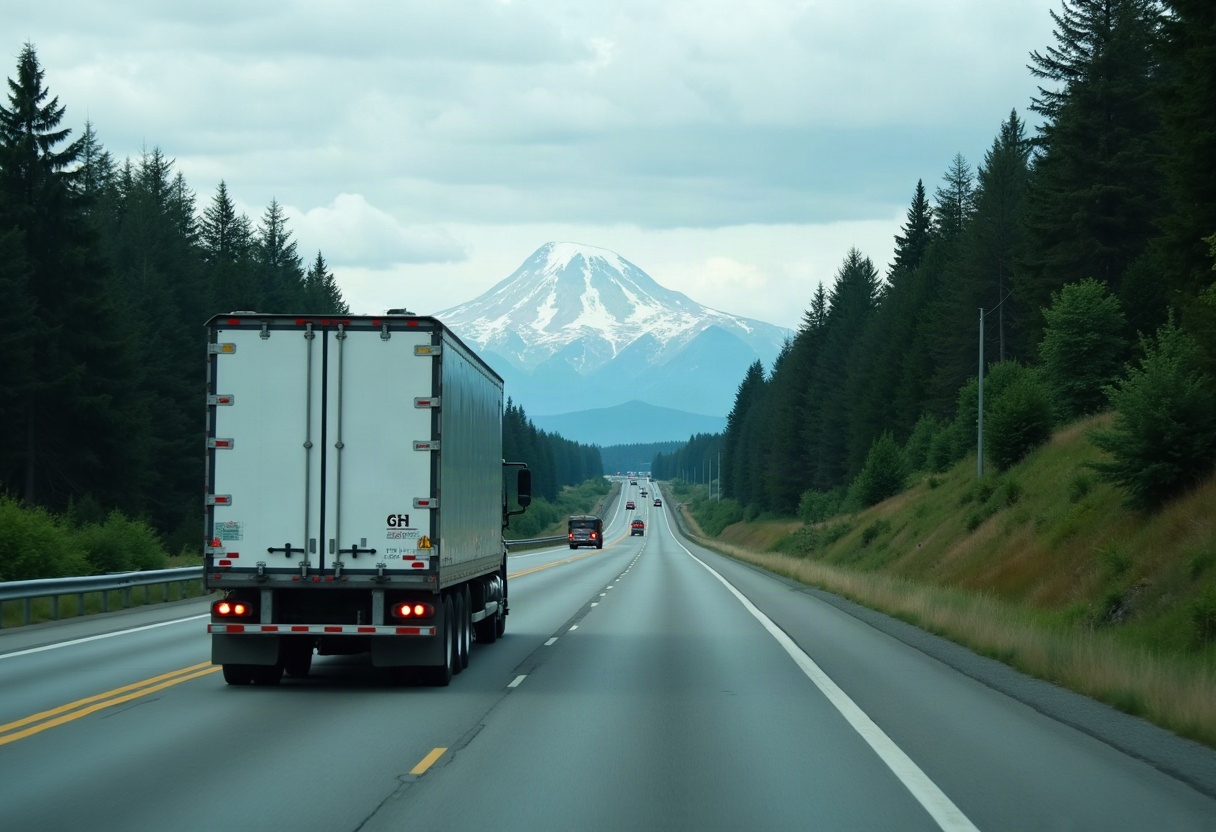
The Seattle to Portland lane is one of the most run full truckload routes in the Pacific Northwest. A shipper with a 26-pallet load leaving a warehouse south of Seattle on a Monday morning wants one answer: what does it cost to put that freight on a truck and deliver it to a dock in Portland by the end of the day. The number is not a single fixed figure — it moves with capacity, fuel, equipment, and the season — but on a 175-mile lane that runs straight down I-5, the rate range is tighter and more predictable than most long-haul lanes.
This guide breaks down what drives the full truckload shipping cost from Seattle to Portland, what rate range to expect on the I-5 corridor, and how to lock in a flat instead of paying spot volatility.
What a Full Truckload Costs on the Seattle-Portland Lane
Full truckload (FTL) pricing on the Seattle to Portland lane is quoted as a flat rate per load, not per mile. The shipper pays for the whole trailer whether it is full or half full, because the carrier is committing the equipment and the driver to that one move.
Dry van, balanced market. A standard 53-foot dry van on the Seattle to Portland lane in a balanced market typically runs $600 to $900 per load. That is the baseline most shippers should expect when capacity and freight are roughly in balance.
Reefer (refrigerated). A refrigerated trailer adds equipment cost and fuel for the reefer unit. Expect $100 to $300 above the dry van rate on this lane, so $700 to $1,200 per load depending on temperature setting and fuel prices.
Flatbed and oversized. Flatbed loads, step-decks, and oversized freight run higher because the equipment pool is smaller and the securement labor is higher. A flatbed load on this lane typically starts above the dry van rate and rises with permit requirements for anything over-dimensional.
Spot versus contract. The numbers above describe a balanced market. In a tight market — peak produce season, holiday freight surge, or a driver shortage spike — spot rates can climb 20 to 40 percent above the baseline. A contract rate locked in a freight agreement holds through those swings, which is why high-volume shippers on this lane run on contract rather than spot.
What Drives the Rate on This Lane
The Seattle to Portland lane is short, dense, and well-supplied with carriers, which keeps the rate range narrow. Four variables move the number.
Fuel prices. The fuel surcharge is the single most volatile component of any truckload rate. It is indexed to the weekly national average diesel price published by the EIA. When diesel spikes, the surcharge rises with it on every load, contract or spot.
Directional balance. The Seattle-Portland lane runs two ways, but freight does not flow evenly. More freight moves south out of the Seattle-Tacoma port and distribution base than moves north out of Portland. A carrier who can find a backhaul north quotes a lower southbound rate; a carrier running empty back north charges more. This is why outbound Seattle rates and outbound Portland rates are not the same number.
Capacity and season. Produce season out of the Yakima Valley and Columbia Basin pulls reefer capacity in the late summer, which tightens the dry van pool as shippers shift. Holiday peak in November and December tightens everything. A load booked in mid-January on this lane costs less than the same load booked the week before Christmas.
Equipment type and accessorial charges. A dry van quote is the floor. Anything that requires a reefer, a flatbed, a team driver, a liftgate, or a residential delivery adds accessorial charges. See our freight cost per mile guide for how accessorials stack onto a base rate.
How to Lock in a Flat Instead of Paying Spot Volatility
If you ship Seattle to Portland more than a few times a month, running every load on the spot market means your rate swings week to week with capacity. Three things stabilize the cost.
Run a contract rate. A freight agreement with a carrier on this lane locks a per-load rate for an agreed volume over an agreed period. The rate holds when the spot market spikes, which is exactly when a spot shipper pays the most.
Consolidate to full truckload when the freight supports it. A full truckload is cheaper per pallet than less-than-truckload once you have enough pallets to fill most of a trailer. If you are shipping 18 to 26 pallets, FTL is almost always the right call on this lane.
Book with lead time. A load booked with 24 to 48 hours of notice gets a better rate than a load booked the same morning. Carriers plan their lanes; a same-day hot load carries a premium because it disrupts the plan.
SeaSound Transport on the Seattle-Portland Lane
SeaSound Transport runs truckload and drayage service on the I-5 corridor between the Seattle-Tacoma metro and the Portland area. We move dry van and container freight on this lane, and we combine truckload with port drayage for shippers pulling containers off the Port of Seattle or Port of Tacoma and delivering them into Oregon. If you have a load to quote on the Seattle to Portland lane — or a container that needs to come off the port and roll south — contact us for a flat rate.